

As previously announced in Point Com’, Centrale Lille is the project leader of “GEEKS FOR EDUCATION (G4E) – inclusive teaching and learning of STEM and digital skills by lifting tech hubs and non-formal education”. This project, launched in 2020 and spanning three years, is funded by the European Union and brings together 12 partners from 7 countries.
After exchanges and activities via videoconferences, face-to-face meetings were held at the IEMN’s premises in Villeneuve d’Ascq, including participants from diverse backgrounds.
Towards a global reflection on education
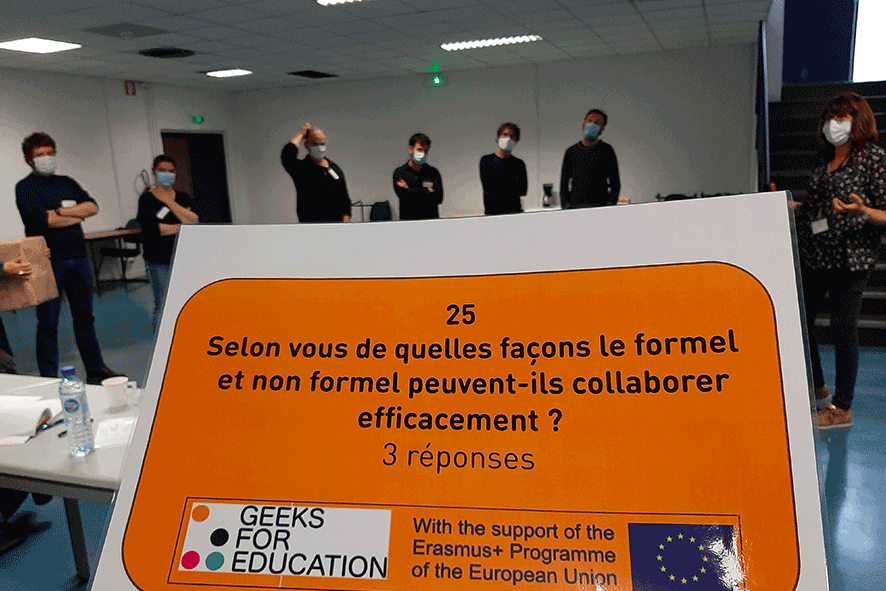 On May 18 and 25, a series of workshops were held at the IEMN. They aimed to close a wider phase of activities, involving teachers and teacher-researchers, but also educators from Lille’s social centres, teachers working in various secondary schools, and technicians from Fablab. The aim was to get the participants, the “geeks”, to deepen their reflection on their skills and abilities as trainers, educators, teachers as well as on their own teaching practices, especially in the field of digital and STEM (Science, Technology, Engineering, Mathematics).
The reference frameworks and values of each were thus questioned, stereotypes and prejudices identified, in order to highlight the notion of equal opportunities. Among the stereotypes identified is girls’ lack of interest in science and digital matters, which is one of the challenges that the Geeks for Education project has promised to tackle.
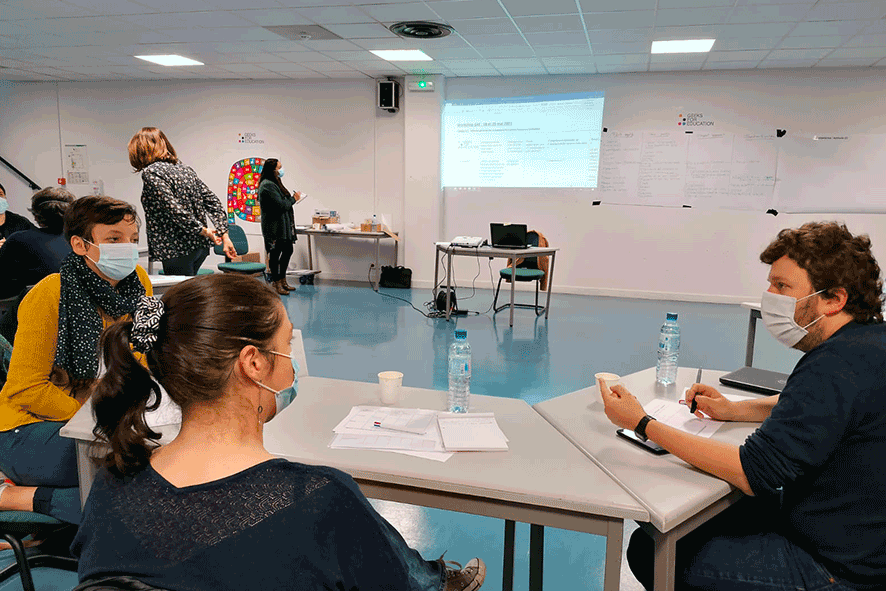 Yannick Dusch, Senior Lecturer at Centrale Lille, testifies to the success of the approach: “Opportunities for real introspection are rather rare! This exercise was an opportunity for me to discover or rediscover my motivations as a teacher, researcher and geek, my way of teaching, the traits and biases that influence it…. It was also a way of stepping back to take a learner’s look and project myself somehow “to the other side of the picture”. These activities undoubtedly contributed to the richness of the exchanges during the workshops, which led to new avenues to improve the transmission of science to as many people as possible. »
A multi-channel approach
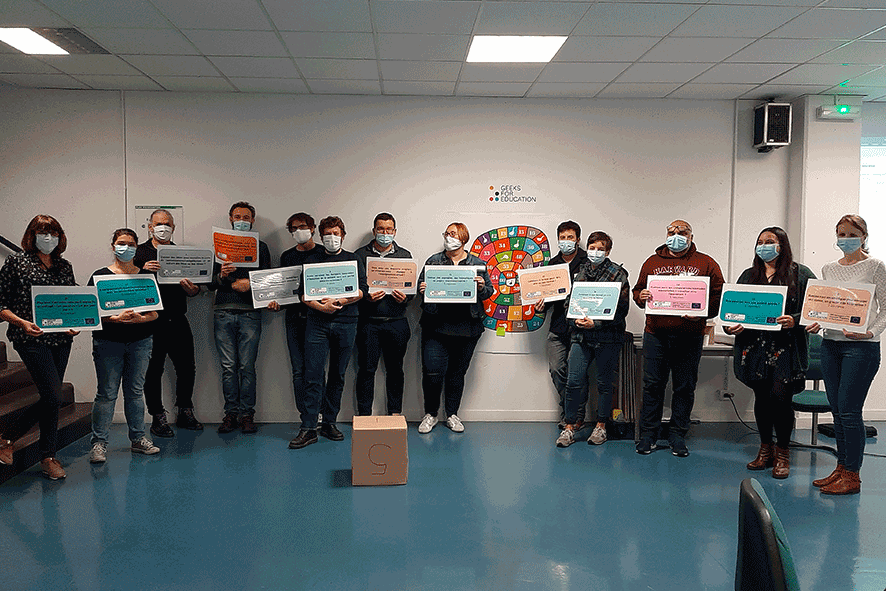 In order to build innovative, transdisciplinary, and inclusive teaching tools, three theoretical cornerstones are explored:
- Connected learning to link practice to theory through experimentation, technical manipulation, and the use of online resources.
- Transformational learning, a cognitive process used to restore meaning to the learning experience.
- European qualifications frameworks that include the 8 key skills, digCompEdu (digital skills of teachers) and LifeComp (personal, social skills and the ability to learn how to learn).
These theoretical cornerstones, combined with the practices and experience of the 12 European partners and their networks, will enable to design training tools for teachers, and pedagogical formats for learners.
Work is currently being carried out on the pooling and mapping of the first results obtained:
- Collecting pedagogical “good practices” through a questionnaire.
- Self-assessment of schools, colleges, and high schools in their use of technology for teaching and learning through the SELFIE tool.
- The self-reflection of trainers/educators/teachers on their pedagogical approaches and practices.
In July, a transnational meeting will be held in Amarante, Portugal, allowing to take stock of these actions and also to serve as a milestone for the project. Local coordinators and a few geeks will be on hand to continue the work and plan for the rest of the activities.