

The educational and digital support centre offers you a focus on the Universal Design for Learning, a concept addressed in the previous post relating to the inclusive educational approach.
The Universal Design for Learning (UDL) is a flexible and inclusive pedagogical approach allowing teachers to programme and organise teaching by offering different means of representation, action and expression, and engagement to meet the varied needs of learners. The UDL is based on three main principles and nine guidelines that set out control points for implementing these principles. It promotes inclusion and learning for all learners, regardless of their needs and abilities.
The three main principles of the UDL are to:
- Offer several means of representation: this guideline consists in offering learners different means to understand the information presented in class.
- Teachers can incorporate visual, sound and text materials to expose information. For example, videos, images, graphics, diagrams, large-print text, audio transcripts or subtitles may be used.
- Offer multiple means of action and expression: this guideline involves offering learners different ways to show their knowledge and demonstrate their skills.
- Teachers can provide several options for educational activities (drawing, writing, speaking, creating videos, etc.).
- Learners can also be allowed to use different tools to show their skills (computer-assisted drawing tools, voice synthesizers, etc.).
- Offer multiple means of engagement: via this guideline, learners have a number of options encouraging them to engage in the learning process (motivation).
- Learners may be encouraged to collaborate, engage in community projects or pursue their personal interests.
- Teachers can offer choices for teaching activities, projects, tasks and learning strategies.
- Teachers can also introduce different presentation formats, such as oral presentations, group discussions, video projects, etc.
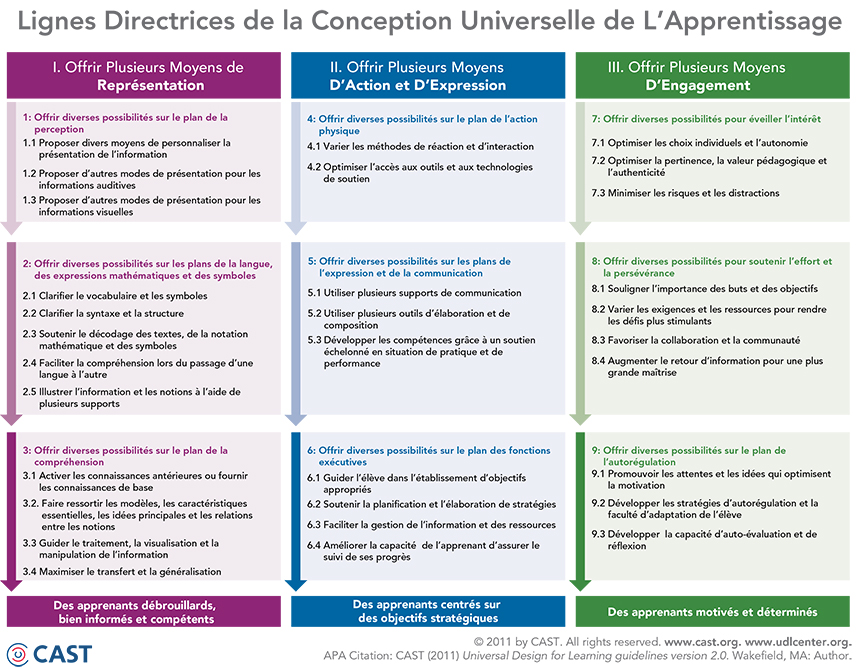
See the guidelines for these three principles here. See an example of how to apply the inclusive approach here.
For more information, by all means contact the educational and digital support centre at .
References:
- Bergeron, L., Rousseau, N. & Leclerc, M. (2011). “La pédagogie universelle : au cœur de la planification de l’inclusion scolaire” (Universal education: at the heart of school inclusion planning). Éducation et francophonie, 39(2), 87–104. https://doi.org/10.7202/1007729ar
- CAST (2011). Universal Design for Learning Guidelines version 2.0. Wakefield, MA: Author.
- Rose, D., Meyer, A. (2002). Teaching every student in the Digital Age: universal design for learning. Alexandria, Va.: Association for Supervision and Curriculum Development.