

The educational and digital support centre (PAPN) offers you a focus on an ideation method in the shape of the World Café. This ideation method encourages exchanges and collaboration between participants to come up with innovative ideas on a common issue.
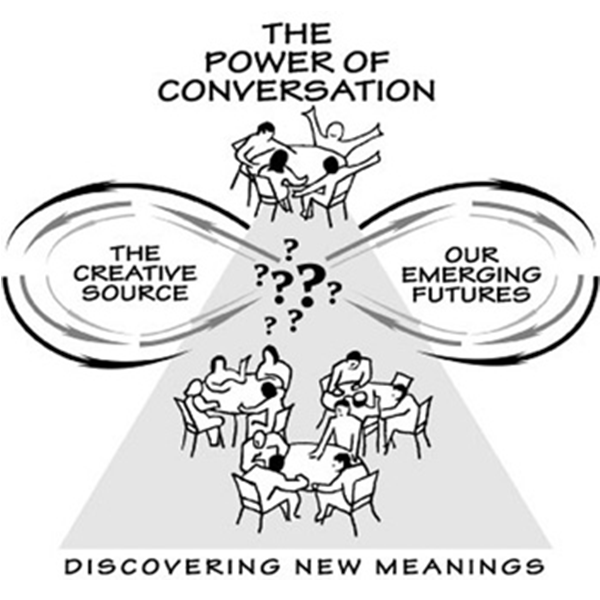 This method takes place in several stages, essentially as follows:
- The participants are seated around several tables, where each small group will generate as many ideas as possible on a common issue.
- After a set amount of time, an audible signal tells participants that it’s time to move to another table. Only the host stays at his or her table to welcome the new guests and give them an account of the ideas expressed by the previous guests.
- New participants will then enrich existing ideas or propose new ones. At each turn, a new host is appointed.
- “Secretaries” are responsible for summarising and presenting their respective results to all participants.
The World Café encourages creativity and collaboration between participants by allowing them to share their ideas and jointly enrich them. This method is often used to brainstorm innovative ideas, stimulate collective reflection on complex issues, and encourage the co-creation of projects. It can be adapted to different contexts and situations, whether in the scope of a company, a community project, higher education or scientific research.
In short, the World Café is a simple, fast and effective ideation method that draws on participants’ creativity and collective intelligence to find innovative solutions to common problems. This method can be used in different contexts, for example, to:
- Encourage interdisciplinary exchange between students.
- Encourage collective reflection on research topics or societal issues.
- Stimulate creativity and collaboration among researchers to generate new problem-solving ideas.
- Gather the expectations of its target users to define a support service.
If you would like more information and/or wish to set up a World Café, by all means contact the educational and digital support centre at .
-
-
References:
- Lallemand, C., (2018). “Méthodes de design UX: 30 méthodes fondamentales pour concevoir des expériences optimales” (2nd edition). Eyrolles.
- The World Café Community. (s.d.). The World Café. Accessed on 4 October 2021 at https://theworldcafe.com/
-